The Science of Hive Ferment
Enzymes, Ecosystems, and the Alchemy of the Hive
It would be tempting to call hive fermentation magical — and in many ways, it is. But like all true magic, it's rooted in science that modern humans are only beginning to understand.
Hive fermentation — the Fifth Ferment — is not mystical because it defies nature, but because it perfectly embodies it. It is a form of bioengineering that predates human civilization, refined over millions of years by one of the most complex social organisms on Earth: the honeybee.
This isn't cottagecore food science. It's ecological genius in action.
Bee Saliva: The Original Enzyme Complex
The first act of fermentation in the hive doesn't come from a microbe — it comes from the mouth of a bee.
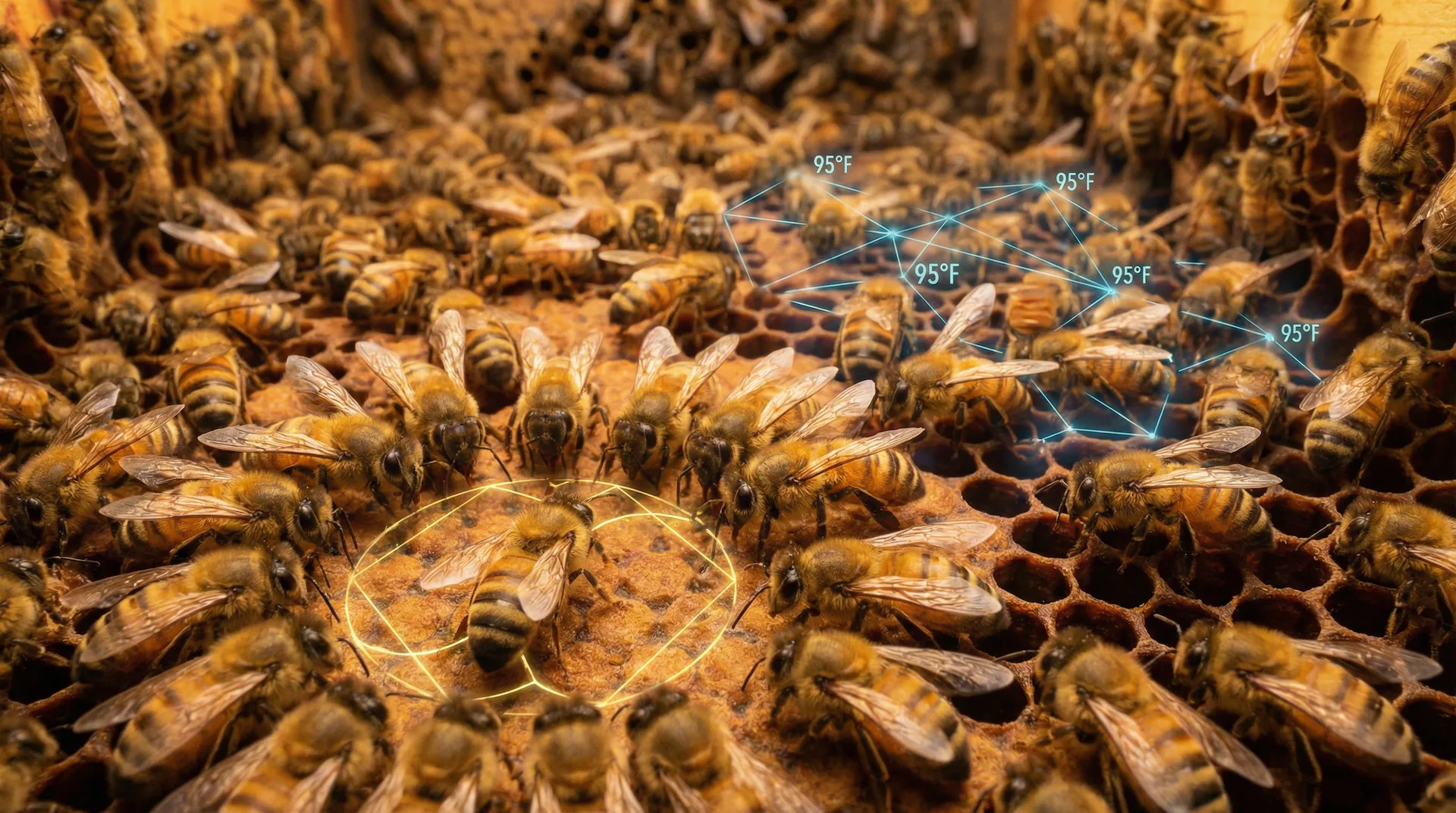
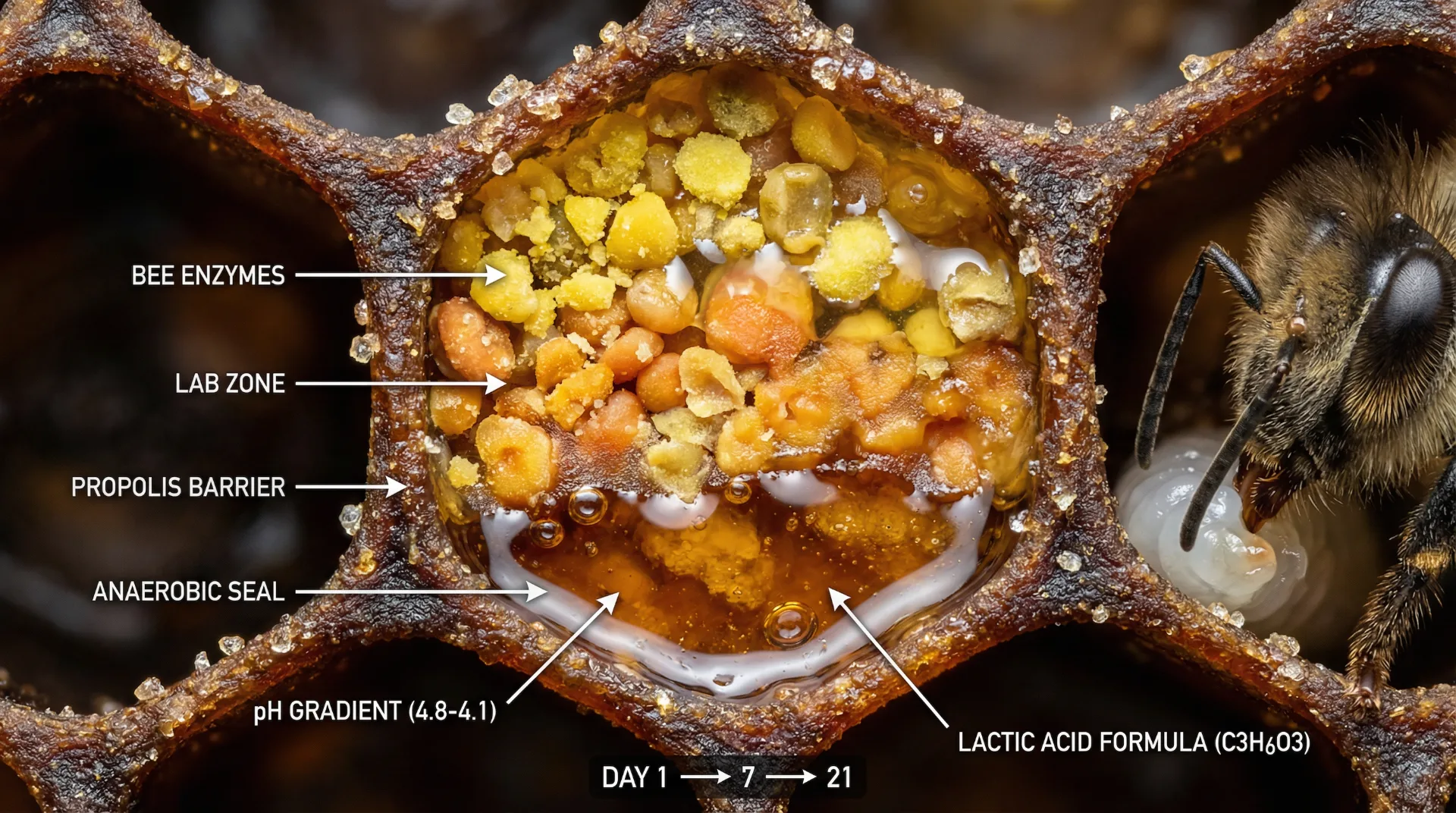
When a forager bee gathers pollen, she mixes it with tiny amounts of nectar and her own saliva, a clear fluid loaded with enzymes secreted from her hypopharyngeal and thoracic salivary glands.[1] These glands produce a sophisticated enzyme cocktail that begins transforming pollen the moment it's collected:
- Invertase (α-glucosidase): Hydrolyzes sucrose into glucose and fructose, making sugars immediately accessible to microbes[2][3]
- Amylase (α- and β-amylase, also called diastase): Breaks down complex starches and polysaccharides into simpler sugars like maltose and glucose[4][5]
- Glucose oxidase: Converts glucose into gluconic acid and hydrogen peroxide, contributing to antimicrobial preservation[6][7]
The hypopharyngeal glands, located in the bee's head, are the primary source of invertase and glucose oxidase, while both head and thoracic glands contribute amylase.[8]
This enzymatic pre-digestion is crucial: pollen grains are encased in a nearly indestructible outer wall called exine, made of sporopollenin — one of the most chemically resistant biological polymers known.[9] Bee enzymes don't break this wall directly, but they soften the pollen structure and begin hydrolyzing the contents that leak through apertures in the grain, making nutrients accessible to both bees and the microbes that will complete the fermentation.
This mixture — pollen softened, unfolded, and enzymatically activated — is not yet food, but not just pollen anymore. It's the beginning of a living transformation.
The bee forms this into a pellet and deposits it deep in the hive, in a wax cell — where the next phase begins.
Anaerobic Alchemy: Lactic Fermentation Without Human Hands
Inside the cell, young worker bees pack the pollen-saliva mixture down tightly. A thin layer of honey seals the top, creating a low-oxygen, anaerobic environment — the perfect conditions for what humans have only recently learned to cherish in foods like sauerkraut and kimchi: lactic acid fermentation.
Native lactic acid bacteria (LAB) colonize the bee bread and drive the fermentation. Unlike typical LAB that prefer glucose, honeybees host a unique group called fructophilic lactic acid bacteria (FLAB), specialized to metabolize the fructose-rich environment of flowers and nectar.
The Dominant Species
Research has identified the key players in bee bread fermentation:
- Apilactobacillus kunkeei (formerly Lactobacillus kunkeei): The dominant species in mature bee bread, specially adapted to the acidic, fructose-rich hive environment
- Fructobacillus fructosus: Another fructophilic species that thrives in bee bread's unique niche
- Lactiplantibacillus plantarum: Found in fresh bee bread, produces lactic acid and antimicrobial compounds
- Lacticaseibacillus rhamnosus: Demonstrates high survival in acidic conditions and shows strong probiotic potential
- Pediococcus pentosaceus: A homofermentative LAB found in some bee bread samples with notable resilience
The Bioavailability Advantage
One of the most remarkable aspects of hive fermentation is how it transforms raw pollen — which is largely indigestible to most animals — into a highly bioavailable superfood.
Fresh bee pollen has only 10-15% digestibility in humans due to its resistant outer wall. Mechanical grinding increases this to about 60%. But bee bread, naturally fermented by the hive, achieves 66-80% digestibility — comparable to high-quality animal proteins.
This is not an accident. This is 100 million years of evolutionary optimization.
The Complete Package
What emerges from this process is not just preserved pollen. It's a transformed substance with:
- Enhanced protein bioavailability (3x higher than raw pollen)
- Increased antioxidant activity
- Probiotic bacterial colonies
- Organic acids that preserve and protect
- Enzymes that continue to work in the human gut
- Bioactive compounds unique to the floral sources
This is food as nature intended it: living, layered, and intelligent.
References (9)
- [1]
Kurek-Górecka, A., et al. 'Structure and antioxidant activity of polyphenols derived from propolis.' Molecules 25.9 (2020): 2153.
View - [2]
Doner, L.W. 'The sugars of honey—a review.' Journal of the Science of Food and Agriculture 28.5 (1977): 443-456.
- [3]
White, J.W. 'Composition of honey.' Honey: A comprehensive survey (1975): 157-206.
- [4]
Bogdanov, Stefan, Tomislav Jurendic, Robert Sieber, and Peter Gallmann. 'Honey for nutrition and health: a review.' Journal of the American College of Nutrition 27.6 (2008): 677-689.
- [5]
Oddo, Livia Persano, et al. 'Composition and antioxidant activity of Trigona carbonaria honey from Australia.' Journal of Medicinal Food 11.4 (2008): 789-794.
- [6]
Weston, R.J. 'The contribution of catalase and other natural products to the antibacterial activity of honey: a review.' Food Chemistry 71.2 (2000): 235-239.
- [7]
Bang, L.M., C. Buntting, and P. Molan. 'The effect of dilution on the rate of hydrogen peroxide production in honey and its implications for wound healing.' Journal of Alternative & Complementary Medicine 9.2 (2003): 267-273.
- [8]
Winston, Mark L. The biology of the honey bee. Harvard University Press, 1987.
- [9]
Roulston, T.H., and J.H. Cane. 'Pollen nutritional content and digestibility for animals.' Plant systematics and evolution 222 (2000): 187-209.